Insight · ticketing
The gate does not wait for the network
Offline-first is not a feature of a ticketing app. It is a promise about what happens when the venue is full and the signal is not.

A stadium holds sixty thousand people and admits them through twelve gates in under ninety minutes. The mobile network at a full venue is unreliable in a way that is not fixable by a bigger data plan, and the queue does not pause while a request retries.
So the design question is not whether the app works offline. It is what the app is allowed to decide without asking anyone.
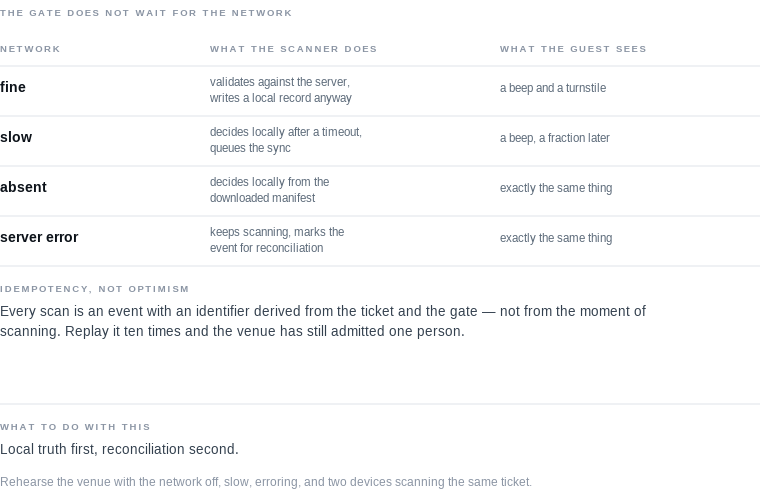
Local truth, then reconcile
A scanner should keep its own record of what it has admitted, decide locally whether a ticket is valid, and sync when it can. That means the device holds a working set — the tickets valid for this gate tonight — and a rule for what to do with a ticket it has never seen.
Two failure modes matter. A duplicate admission, because two gates read the same ticket and neither knew about the other. And a false rejection, because the device’s set was stale.
Idempotency, not optimism
Every scan is an event with an identifier derived from the ticket and the gate, not from the moment of scanning. When the same event arrives twice — once from the device, once from the retry — it is counted once. Without that, a flaky connection turns one guest into three.
For the stale set: a short validity window on the local data, with a visible indicator on the device when it is running on an old snapshot. The operator needs to know which mode they are in, because the recovery action is different.
Rehearse the venue, not the app
Test with the network off, with the network slow, with the server returning errors, and with two devices scanning the same ticket. Do it at the gate, at the hour, with the staff who will be there. A test in a meeting room proves the code compiles.
The measure of success is not uptime. It is the number of guests who had to leave the queue for a desk, and the number of minutes the queue took to clear after the doors opened.

Working through this now?