Insight · ai
A private model needs a private corpus
The model is a commodity. The corpus, the permissions and the citations are the project.

An on-premise retrieval platform for regulated documents sounds like a model problem. It is not. The model is the part you can replace in a week; the corpus is the part that decides whether the answers are worth reading.
Three things have to be true before a single query is useful: the documents exist in a machine-readable form, the permissions on them are enforceable at retrieval time, and there is a way to tell a good answer from a plausible one.
Permission is a filter, not a feature
In a regulated setting, the first question about any answer is who is allowed to see the source. That has to be enforced in the retrieval layer, per document, using the same access model as the document store — not by asking the model to be careful.
It also has to be auditable: for each answer, which chunks were retrieved, from which documents, under whose entitlement. Without that log, the system cannot be approved, however good the answers are. The log is usually the difference between a pilot that ends and a platform that ships.
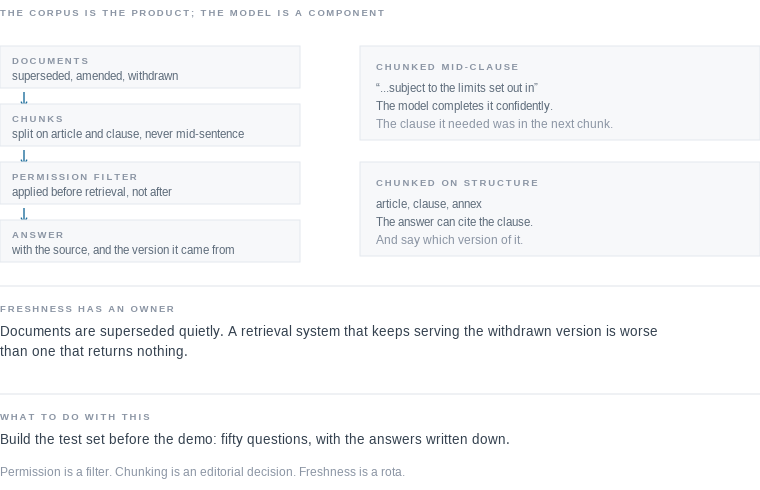
Chunking is an editorial decision
A regulation split mid-clause produces confident nonsense. Chunk on the document’s own structure — article, section, annex — and keep the heading with the text. The quality difference is larger than any change of model.
Then keep the citation. An answer without a paragraph reference is an opinion, and opinions are what the current process already has too many of. A citation also tells the reader where to look when the model is subtly wrong, which saves the whole feature from being distrusted after one bad answer.
Freshness has an owner
A corpus is not a snapshot. Documents are superseded, amended and withdrawn, and a retrieval system that keeps serving a withdrawn version is worse than no system at all, because it is confidently out of date.
So ingestion needs a schedule, a source of truth per document type, and a visible date on every answer. The question “how old is this?” should be answerable in one click.
Build the test set before the demo
Fifty questions with known correct answers, written by the people who will use it, including the twenty that are hard. Run every change against them and publish the score. Without this, every improvement is a matter of taste.
The model will be better next year. The corpus, the permissions and the test set are the assets that make that improvement worth anything.

Working through this now?